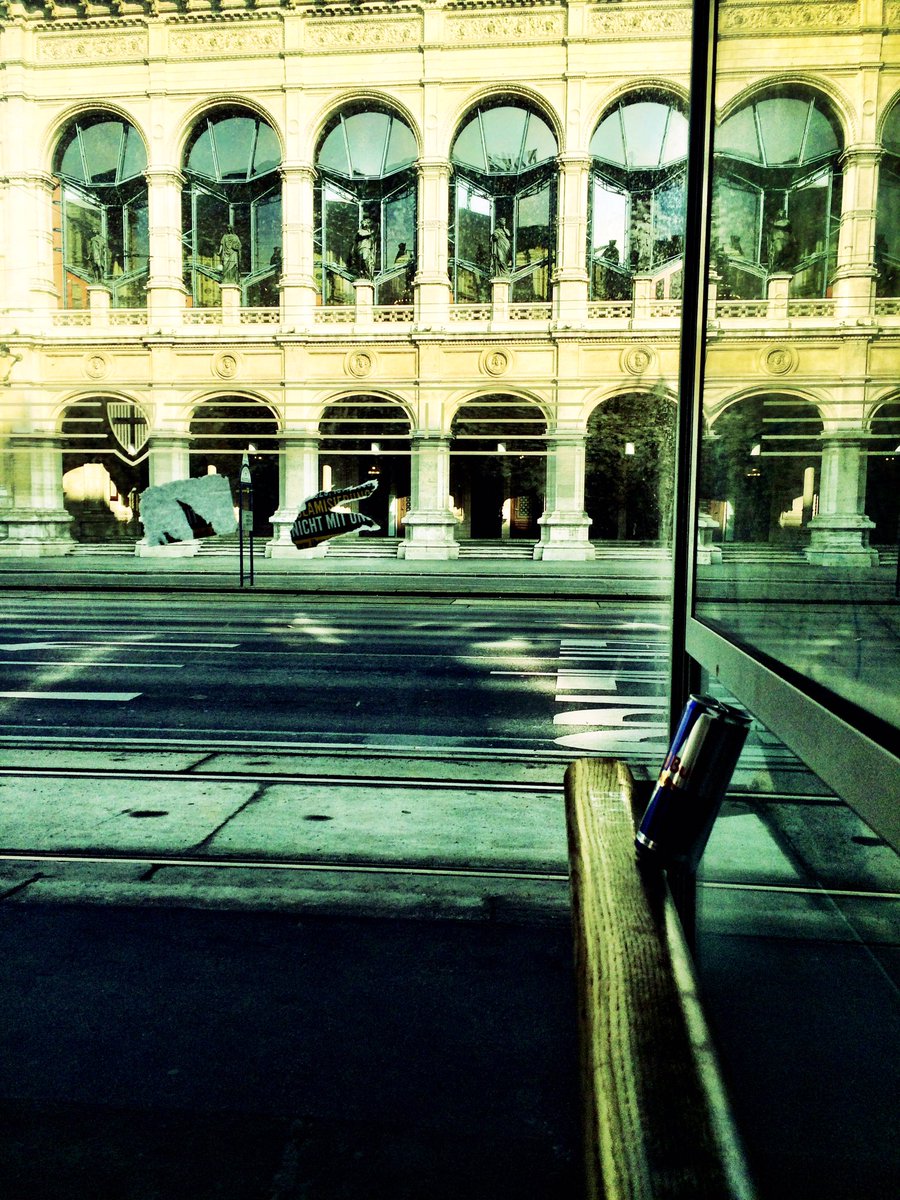
Back in the day when Twitter was like Ken’s house at the end of Toy Story 3 (cool and groovy) I would sometimes use my account to post pictures with the hashtag “Red Bull Graveyard”. As the name implied, the photo would feature a discarded Red Bull can and it was just an attempt capture the ubiquity and last resting places of these colourful, aluminium containers in the most mundane of settings.
Yet, over time, it morphed into something where juxtaposition became more appealing. For example, a solitary can placed in the middle of the pavement in front of Stephansdom. Or on holiday in the Lungau in Salzburg, an otherwise pristine location, 1000 metres above sea level and far from the filthy capital, a single can by the side of the road backdropped by some stunning mountains. Although, in truth, my favourite to this day a more evocative example: an empty can in a supermarket left nestling between some boxes of eggs in a fridge.
I admit, it was a niche pursuit, even for Twitter. But there were a couple of reasons why I thought Red Bull deserved my attention. First, in the many years living and moving around the capital of Austria (mostly), I concluded that eighty percent of the litter on its gilded streets were discarded energy drink cans, and eighty percent were some derivatives of Austria’s favourite taurine-soaked tipple. (For the record, the next main offenders were, in this order: beer cans, cigarette packets, discarded tissues in winter, ice-cream wrappers in summer, and interestingly if only what comes later, the occasional plastic bottle. Although I should add that the single biggest offender was/is discarded cigarettes but posting pictures of this on Twitter or any other platform given the number and frequency would have broken the internet, and I didn’t want that on my conscience.)
My second reason was not only that Red Bull was the most visually distinctive brand in Austria (and hence unmistakable even in a bush) but it was, and continues to be so by some distance, Austria’s most valuable. (According to the European Brand Institute, its value in 2025 was nearly 20 billion Euros.) As such, it seemed wholly incongruous and equally vexing that the one product contributing to the litter-based degradation of the immediate environment in Vienna more than any other, left on grass verges, by the side of the roads, in fields, at bus-stops or just simply crushed on the streets by a passing car (thrown from another car), was the source of wealth for Austria’s richest man. Although he, Didi Mateschitz, really got the chance to find out if Red Bull “gives you wings” as he died in 2022 meaning his son is now Austria’s richest individual (and reputedly the wealthiest under 32-year-old on the planet). Still, you might think that if a convicted felon could become President of the United States, then it would be easy for such enormous wealth from a drink’s company to find a way to incentivise their customers to find a fucking bin. But what do I know?
In any case, I know this bombshell will shock some of you. To learn that Vienna, hall-of-famer for life quality and much, much more, has litter. But Red Bull Graveyard couldn’t work today because something has happened in Austria after a long overdue change of legislation introduced this year.
Back in January the law was changed so that almost all plastic bottles and aluminium cans are now subject to a twenty-five-cent refundable deposit. “Pfand”, as it is known here, is well-known in Austria (and Germany) in that for years when you bought a bottle of beer you always paid a small deposit for the bottle (until, March it was nine cents in Austria) which you could reclaim when you brought it back to any supermarket and inserted in a special machine called the Leergut. We do not have to go into any detail here, but it also included the larger glass mineral water and milk bottles, and it worked perfectly well. So much so that it was unusual to see empty glass beer bottles lying around because nine cents was, well, nine cents.
But now we are in a brave new world and once the revised deposit scheme took hold and the newly “branded” cans and bottles came into the supply chains (the shake out took a couple of weeks), it had a remarkable and swift impact on the litter habits of the Viennese at large. Alongside some related consequences which we will come to in a moment, the most striking, certainly from my corner of the Vienna experience, was how quickly the Red Bull litter-based menace (and all its cheaper imitations) seemed to disappear. In other words, the graveyard appeared to have, well, deceased.
I can be certain of this because most weekends I try to spend an hour or so cycling. I have a couple of routes but my preferred is to cycle east from the 23rd district where I live in Vienna, towards the sleepy urban villages of Oberlaa and Unterlaa on the southern fringes of the city. The route works well for litter observation because it encompasses thoroughfares with plenty of grass verges (the favoured last resting place of the energy drink can pre-2025), backstreet suburban streets, streets bordering farmland, paths across farmland and one cycle path alongside the Liesing stream. In other words, there is a perfect mix of potential resting places especially as some of the sections are relatively free from people and thus prying eyes (and potential social censure) meaning it is just easier to lob your litter and skedaddle. And people did.
During these 15-20 km cycle-trips I would stop counting the Red Bull cans (just the Red Bull cans mind you) when it got more than twenty. Admittedly, it would fluctuate over time, sometimes more sometimes less, but it was a guaranteed visual spectacle on EVERY trip. But in the last few months, whether cycling or out walking, I spot almost none.
But before we crack open the Sekt (no deposit on wine, sparkling wine or spirit bottles) there have, of course, been some murmurings of discontent. Inevitably the far-right whingers of the Freedom Party are the most vocal, saying that not being able to discard your cans and bottles in a hedgerow is an infringement on personal freedom. Moreover, there have also been some rumblings from small businesses and shoppers about the implementation and inconveniences of returning the empties. And in truth, it is still possible to see the remnants of some drink containers (McDonalds and those cold coffee type concoctions seem the obvious offenders). Likewise, the occasional can pre-dating the deposit changes (i.e. old stock) which I always pick up on my walks and then mail to the headquarters of Red Bull or Coca-Cola (postage paid on receipt). But I am cautiously optimistic even though Vienna has been downgraded again this year to number two city due to Taylor Swift.
However, I promised you a couple of consequences:
1: The Queues
When the return machines in supermarkets were just dealing with beer, milk or mineral water, the act of returning bottles was relatively quick. Why? Because if you were in the market for more than a six-pack of beer each week or were having a party say, you probably bought a crate (holding twenty bottles). Cleverly, the machines not only had the option of retuning individual bottles, but it was also possible to return a whole crate in one go. In other words, placing in one bottle took about as much time as placing in a crate of twenty. It also worked the same for mineral bottles and milk. But now, with people clutching bin-bags stuffed with individual 25-cent treasures and given that it takes a couple of seconds to process each item in the machines (Spar has separate ones for glass, Billa not), it is not unusual to see queues of people tutting furiously at the ineptitude of the person in front to be so slow. And remember this is a Viennese queue so even if you are standing there with a bin-liner full of empty plastic bottles, holding a placard declaring you are in the queue to return your empties, someone will still ask, pretending not to see the queue, if you are standing in the queue for people with empty plastic bottles. And then feign surprise when you say yes.
2: The Grabbers
As word spread that there was money to be made the entrepreneurial leapt into action. So much so that now it is not unusual to see human versions of Wall-e searching through the public bins on the hunt for overlooked twenty-five cent treasure. This also includes famous “Gelbetonne” found on every street corner and previously used for the recycling of plastic bottles, packaging and cans, because some people will still throw away, unwittingly or not, a deposit branded vessel. However, this has also in some cases extended to upending bins in public spaces (parks seem a favourite) which is causing some consternation and thus demands for separate bins to make retrieval easier for the scavengers.
Of course, I have practised casual litter picking for years because I am a proud member of the tree-hugging, liberal wokerati. Indeed, I also have a grabber and alongside the grab mechanism it also has a little spiky thing to spear discarded wrappers, packets and any obvious associate of the far-right if they get too close. Which is good to know given that I recently learned that my local and only boozer – Koci – is reputedly known as the “FPÖ” (Freedom Party) pub. Well, I suppose the plan to return to Vienna to its rightful spot as the number one city must start somewhere. And where better than a beer garden and some rousing words. What could possibly go wrong?
(C) Robert J. Barratt 2025
 Up The Danube Without A Paddle. Years and Years In The Number One City.